Rock guide
Petoskey stone
Michigan's state stone is a coral reef you can hold in your hand.
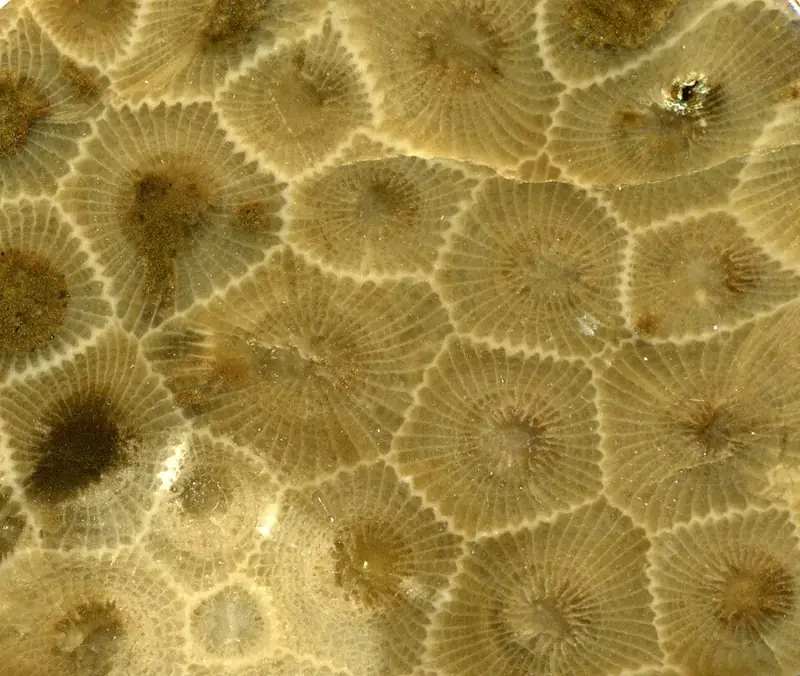
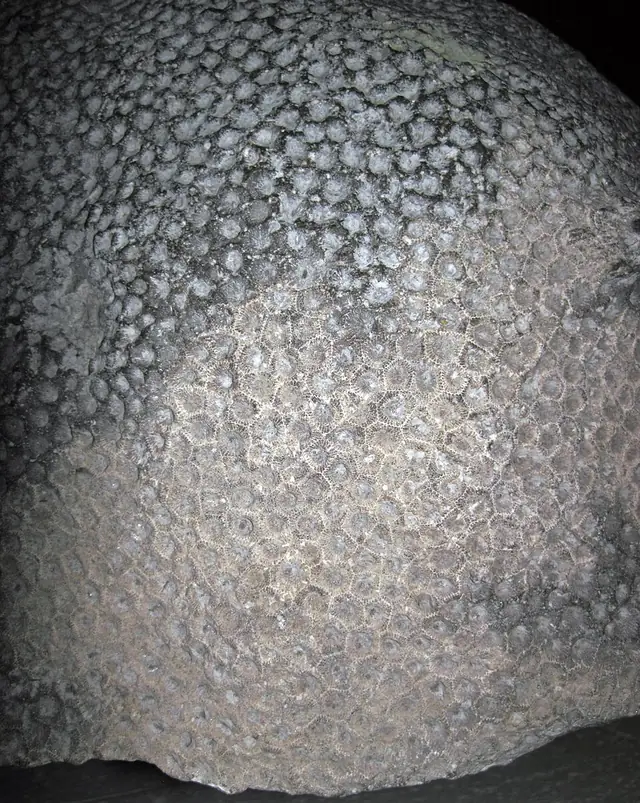
What is a Petoskey stone?
A Petoskey stone is a fossil of a colonial coral, Hexagonaria percarinata, that lived in a shallow sea during Devonian time.2 It dates from the Middle Devonian, 393 to 382 million years ago,1 which matches the Middle Devonian on the international time scale.4
The species that makes Petoskey stones is found only in the Gravel Point Formation of Michigan,5 part of the Traverse Group. Those reef limestones occur in Charlevoix, Emmet, Cheboygan, Presque Isle and Alpena counties.6
The stones are mostly calcite, though quartz, pyrite and other minerals can be present.7
Michigan made it the state stone in 1965 (Public Act 89 of 1965, effective March 31, 1966). The law reads: "The Petoskey stone is hereby adopted as the official stone of the state of Michigan."8
How do you identify a Petoskey stone?
- Look for six-sided cells called corallites, the skeletons of the coral animals. Each has a dark center, or eye, which was the coral's mouth, and the lines around it were once tentacles that brought in food.2
- Waves tumble the stones smooth and round. That shape, the six-sided pattern and a gray to brown color make Petoskeys stand out.2
- Get it wet. Walk the surf zone where rocks are wet, or splash water on dry ones. EGLE says this works especially well for Petoskey stones.3
- Look closely: each star-like cell has a central pillar, the columella, with lines called septae that radiate out like the spokes of a bicycle wheel.5
Look-alikes
Charlevoix stone, horn corals and more
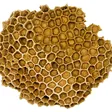 Charlevoix stone
Favosites, a tabulate coral. Its cells are small and tightly packed, only a few millimeters across, with no central pillar.35
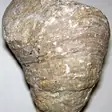 Horn corals
Solitary corals with one cone-shaped cell. In Hexagonaria, many cells stay in close contact.5
 Other Hexagonaria
At least seven Hexagonaria species are found in Michigan's Devonian rocks, and they are hard to tell apart at a glance.7
EGLE also lists Syringopora (pipe coral) and Halysites (chain coral). Bryozoans have tiny, pin-prick sized holes instead of large cells.3
Where can you find Petoskey stones?
They are most common on northern beaches, but they also turn up farther south. Known collecting places run from the public beach in Frankfort to Fort Gratiot County Park, and they have been found inland in many sand and gravel mines across the state.3
Why so widespread? Ice Age glaciers plucked Petoskeys from the bedrock and spread them across Michigan and nearby areas.7
At Petoskey State Park, the DNR says Petoskey stones can be found in abundance.9 See Northwest Lower Peninsula.
Hunting tips from EGLE
Can I keep a Petoskey stone?
On state land, Petoskey stones count as invertebrate fossils toward the 25 pound per person per year limit in R 299.922(hh).10 25 lb per year on state land
National lakeshores are different: see the national park rules.
Sources (10)
- University of Michigan Online Repository of Fossils, Michigan backyard fossils: corals. https://umorf.ummp.lsa.umich.edu/wp/mi-backyard-fossils-corals/ (checked October 21, 2026)
- Sleeping Bear Dunes National Lakeshore (NPS), Beaches. https://www.nps.gov/slbe/learn/nature/beaches.htm (checked October 21, 2026)
- Michigan EGLE, Fossils. https://www.michigan.gov/egle/public/learn/geology/rockhounding/fossils (checked October 21, 2026)
- International Commission on Stratigraphy, International Chronostratigraphic Chart, v2026/06 (PDF). https://stratigraphy.org/ICSchart/ChronostratChart2026-06.pdf (checked October 21, 2026)
- University of Michigan Museum of Paleontology, Hexagonaria percarinatum. https://lsa.umich.edu/paleontology/resources/beyond-exhibits/hexagonaria-percarinatum.html (checked October 21, 2026)
- A. E. Seaman Mineral Museum (Michigan Tech), Mineralogy of Michigan: Calcite (PDF). https://museum.mtu.edu/pdfs/CALCITE.pdf (checked October 21, 2026)
- Michigan EGLE, Petoskey Stone handout (PDF). https://www.michigan.gov/-/media/Project/Websites/egle/Documents/Programs/GRMD/Catalog/04/GIMDL-GGPS.PDF (checked October 21, 2026)
- Michigan Compiled Laws, MCL 2.16 (state stone). https://www.legislature.mi.gov/Laws/MCL?objectName=mcl-2-16 (checked October 21, 2026)
- Michigan DNR, Petoskey State Park General Management Plan (PDF). https://www.michigan.gov/dnr/-/media/Project/Websites/dnr/Documents/PRD/MgtPlans-archive/Petoskey_GMP.pdf (checked October 21, 2026)
- Michigan Administrative Code, R 299.921 to R 299.933, State Land Use Rules (Department of Natural Resources). https://ars.apps.lara.state.mi.us/AdminCode/DownloadAdminCodeFile?FileName=R+299.921+to+R+299.933.pdf (checked October 21, 2026)